
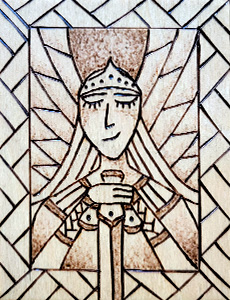
 Valkyrjur Basics
Valkyries are among the best-known and certainly the most iconic figures of Norse mythology. Also known as Valkyrja and Valkyrjur in Old Norse, and Wælcyrge and Wælcyrie in Old English. Their name means “Chooser of the slain.”
They are a group of goddesses who serve as an honour guard to the god Óðin. They decide the outcome of battles, arranging who will live and who will die. They select souls to go to Valhöll, where they will have both rest and delight, as well as prepare for a greater cosmic battle as Óðin’s soldiers. These chosen are called the Einherjar (Once Fighters). In addition to death-dealers and afterlife escorts, Valkyries act as lovers and spirit-wives to the slain and serve them mead and ale in the life beyond. They are attested to in the Poetic and Prose Eddas, in Njals Saga, and in the archeological record.
They are described as beautiful, regal women, dressed in fine battle armor, astride magnificent horses, or at other times terrifying wolves. They are shapeshifters, often appearing on battle fields as murders of ravens and crows. Occasionally they are described as a swarm of bees. They commonly also appear as horses, and as swans when washing and in a state of disarming and disrobing.
The Valkyrjur are highly theatrical. They are described as in flight, often astride air-born horses. Often they make their debuts in the form, or accompanied by, various temperamental weather phenomena, including storm clouds, mist, howling wind, crashing waves, and intense cloud-parting sun showers. They are also associated with the Aurora Borealis, said to be light reflecting off their armor. Like the tempestuous weather extremes, they also appear both foul and fair in their dress, in sometimes gleaming polished armor, and other times drenched in gore and blood. They sometimes appear as nymph-like Swan Maids, and other times they are described as witchy troll women who bask in corpses and slaughter.
They are sometimes accompanied by otherworldly beautiful singing, and at other times intense and horrifying cacophony. They are often associated with the Nornir the meta-goddesses of fate, and with the Disir, the protector ancestresses of any particular lineage. Their titles include Óskmey (Wish Maid), and Óðin’s Meyjar (Odin’s Maids), and perhaps their most well-known title: Shield Maidens.
Though they function as a team, they are given individual names. Their names tell us something of the group’s character:
Geirdriful (Spear Flinger) – Geirskögul (Spear-Shaker) – Gunnr (War) – Göndul (Wand-Wielder)
Hildr (Battle) – Hrist (Quaking) – Hrund (Pricker) – Hjörþrimul (Sword Warrior)
Hervör Alvitr (All Wise) – Hjalmþrimul (Helmet Clatterer) – Hlaðguðr Svanhvít (White Swan) – Herja (Devastate)
Kára (Wild) – Ölrún (Ale Rune) – Róta (Sleet Storm) – Reginleif (Power Trance)
Ráðgríðr (Bossy) – Randgríðr (Shield Destroyer) – Sanngriðr (Cruel) – Sigrdrifa (Inciter of Victory)
Sigrún (Victory Rune) – Skalmöld (Sword Time) – Skeggjöld (Axe Age) – Skögul (Shaker)
Sveið (Noise) – Svipul (Changing Fate) – Þrima (Flight) – Þögn (Silence)
They also have individual identities and several Valkyrjur play roles elsewhere in the lore. Þrúðr (Strength) is Thor’s daughter. Eir is one of Frigg’s handmaidens, and the Valkyrie who is largely responsible for those who will recover and live. She is considered to be a goddess of healing within the pantheon. Perhaps the most famous individual Valkyrja is Brunhild, also known as Brunhilda or Brynhild, one of the main characters in the Völsunga Saga, who becomes a sort of fallen-Valkyrja.
The Romans often equated them with the female companions of Mars and Ares, such as Bellona, Enyo, and Discordia.
Ydalir.ca
Signs and Symbols
Warrior women, ravens, crows, swans, horses, wolves, intense weather patterns, Aurora Borealis, cacophonous noise, drinking horns.
Ydalir.ca
Associated Names
Valkyrja and Valkyrjur in Old Norse, and Wælcyrge and Wælcyrie. Valkyrie and Valkyries.